Marrakech, Morocco
September is the exact window: temperatures drop from summer's 40°C to a more livable 28–32°C, Europeans are back at work, and the Medina regains the human scale that July and August strip away. For the woman traveling solo for the first time in an Arab destination: Marrakech is safer than most prior fears suggest, and more transformative than any guide can anticipate.
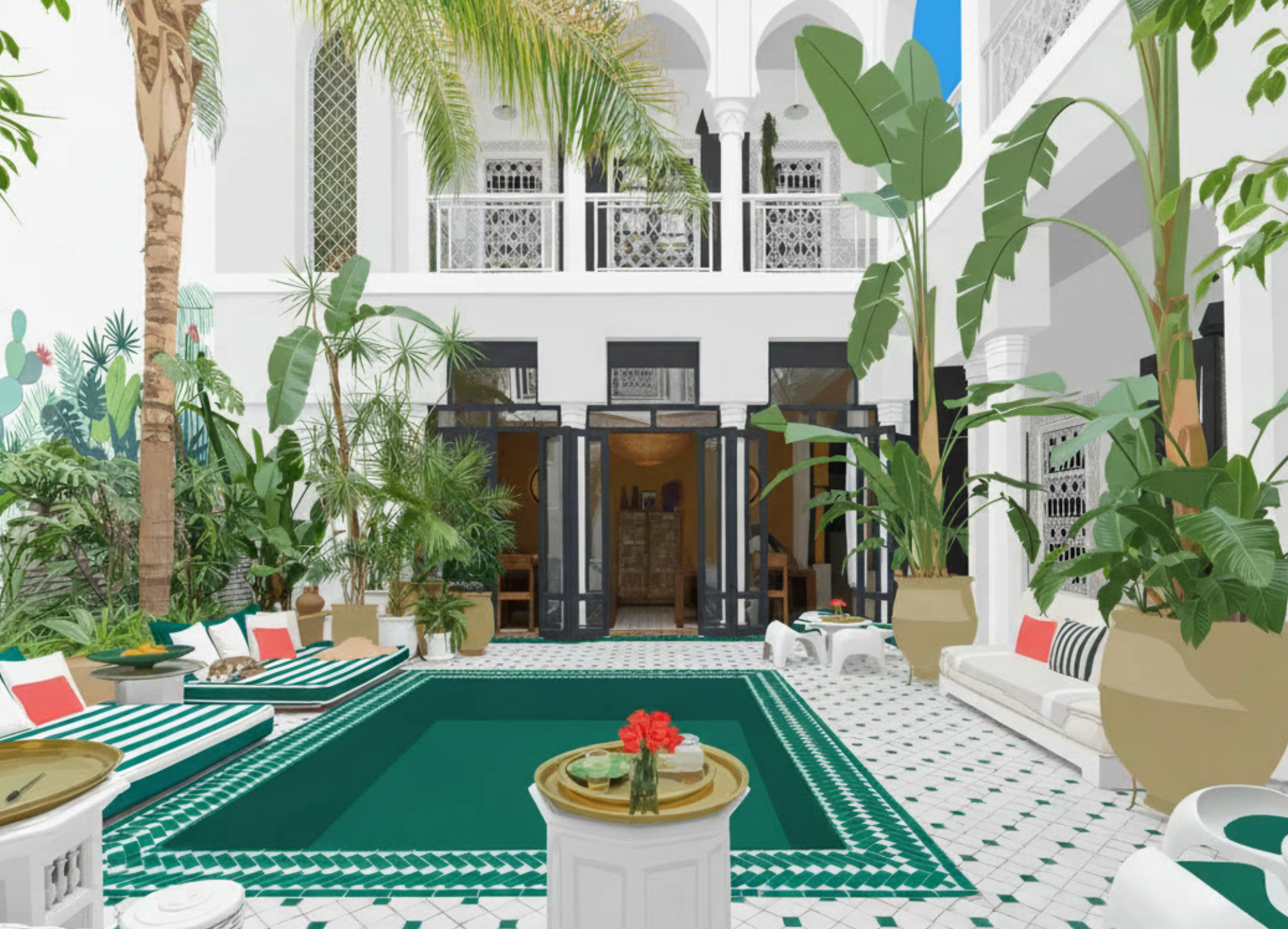
A miniature palace of cedar wood and Fez brick, a few minutes' walk from Jemaa el-Fna, tucked into a quiet derb well outside the mass-tourism circuit. Five suites decorated in traditional zellige and Moroccan stucco, a solarium with a tiled jacuzzi, and views of the Koutoubia and Mulay Idriss Palace from the terrace. The owner cooks breakfast himself: bread baked that morning, rose jam, Berber eggs. Estimated price: €150–280/night.
✦A miniature palace minutes from Jemaa el-FnaIn Mouassine, the Medina's most elegant and least crowded neighborhood, steps from Le Jardin Secret and an eight-minute walk from Jemaa el-Fna. A private pool in the courtyard, a terrace with views of the Koutoubia, the Two Brothers (Atlas peaks), and the courtyard of Mulay Idriss Palace. Surrounded by art galleries, design boutiques, and the Medina's best restaurants. For the trip's most elegant night: Mouassine at 10pm has the quiet of a residential neighborhood and the polish of a destination that hasn't made it onto every map yet. Estimated price: €180–350/night.
✦A private pool in the Medina's most elegant cornerA ten-minute walk from the main souk and Jemaa el-Fna Square, with its own spa and hammam available to riad guests. Reviews consistently single out the staff and the spa as the property's two standout features. For the days built around hammam and argan massage after walking the Medina: having the spa inside the riad itself removes the logistics and adds privacy. Estimated price: €130–240/night.
✦Its own spa and hammam, no need to leave the riadMarrakech's most recommended workshop for learning the two core techniques of Moroccan pottery: the traditional potter's wheel and hand-molding. The artisan Tariq — named by title in dozens of reviews — has run his workshop facing Jemaa el-Fna Square for 30 years, working through his translator Khaoula, who turns every instruction into a short lesson on the history of Moroccan craft. Includes clay preparation, firing and glazing, and the requisite mint tea between pieces. For the solo woman traveling with the intention to learn something: this is the most recommended workshop available.
The atelier of a certified craftswoman specializing in the two molding techniques most practiced in the workshops of Fez and Marrakech. The class includes a break for Moroccan tea with pastries made on-site — the only moment of the day when clay-covered hands and sugar in your tea coexist without contradiction. For the woman who wants the more intimate workshop: Lamsaty works with small groups.
The sanctuary of Ferme Sidi Safou, 20 minutes from Marrakech, combines a traditional Moroccan cooking class, a pottery workshop, and a mosaic workshop into one full day, with lunch prepared on-site. The countryside setting — olive trees, pomegranates, aromatic herbs — makes this the day furthest from the Medina's tourist circuit, and the closest to the crafts the whole trip is built around.
The name Marrakech comes from the Berber mur n'akush, meaning "land of God." The city was founded in 1062 by the Almoravids, the Berber dynasty that also built the Koutoubia and part of the Great Mosque of Seville in Spain. The blue popularly associated with Morocco isn't from Marrakech — it's from Chefchaouen, in the north of the country. Marrakech is the pink city: the color of the local stone, imposed as urban law by the authorities in the 20th century.
Turn this guide into a personalized AI itinerary — exact dates, travelers, and budget for your trip in 60 seconds.
Plan my trip →Marrakech Menara International Airport (RAK), 6 km from the city center. Direct flights from Madrid, Barcelona, Paris, London, Amsterdam, and several other European cities. From Mexico: connect via Madrid (Iberia, 2 hours + 3.5 hours) or Paris (Air France, 12 hours + 3.5 hours). Official airport taxi to the Medina: 70–100 MAD (€6–9 EUR).
The Medina has no car traffic on most of its streets — everything is on foot or by bicycle. Riads inside the Medina sit in alleys taxis can't reach: the driver stops at the entrance to the derb, and from there you walk in with your bag. For excursions into the Atlas: private taxi, organized tour, or a day driver ($30–60 EUR per excursion).
Marrakech has a reputation as a difficult destination for women traveling alone — partly earned, partly overstated. The Medina is safe by day; at night, the main alleys are well lit. Jemaa el-Fna Square at night is lively and requires no more caution than any European plaza. Unsolicited "guides" at the souk entrance (faux guides) are handled by being direct and walking with purpose. The riad solves the part that matters most: a locked door on the other side of which the outside world doesn't come in.